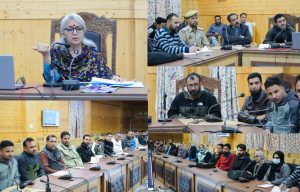
BANDIPORA, APRIL 17: Deputy Commissioner Bandipora, Indu Kanwal Chib, today chaired a review meeting with resource persons to assess the implementation of the Nasha Mukt Abhiyan under the ongoing 100-Day Mission Mode Campaign and to take feedback on IEC (Information, Education and Communication) awareness programmes.
During the meeting, the DC interacted with resource persons, who shared their field experiences, challenges, and suggestions. She specifically sought reasons for low participation in certain IEC activities.
The DC emphasised the need to reassess outreach strategies to ensure that awareness efforts are effectively reaching the intended target groups. She underscored the importance of establishing an emotional connect, noting that different age groups require tailored approaches. She also clarified the distinction between orientation and training, stating that structured de-addiction training will be provided to interested individuals.
On the occasion, ACD Bandipora stressed that awareness content should be delivered in simple language and preferably in the mother tongue to ensure clarity and better public engagement. It was also emphasised that programmes should prioritise impact and behavioural change over mere numerical coverage.
Resource persons from various departments shared valuable insights. The ATF informed that multiple training sessions have been conducted on handling addiction cases, identifying early warning signs, and leveraging the role of religion in prevention. Teachers highlighted concerns such as increasing social isolation among youth and lack of adequate recreational spaces. Health department representatives pointed to behavioural indicators like withdrawal, changes in routine, and emphasised the need for early screening and regular parent-teacher interactions.
Reiterating the role of families in prevention, the DC stressed the importance of strong communication between parents and children. She urged parents to closely observe changes in behaviour, habits, and peer groups of their children, and not to ignore early warning signs. She further advised that simple practices such as regularly sharing meals and engaging in indoor activities with children can help families stay connected and better monitor the well-being and movements of adolescents.
Officials from Social Welfare and other departments noted that neglect of children and lack of parental engagement are significant contributing factors. It was informed that awareness programmes are being conducted across schools and Panchayats, covering both substance and non-substance addictions, including excessive social media use.
Police and other stakeholders stressed the importance of community participation, religious engagement, and promotion of sports activities as preventive measures against substance abuse.
The DC directed that the single-point contact number under the Nasha Mukt Bharat Abhiyan be widely shared for greater accessibility. She also called for systematic collection of data on addicts and recovered individuals to enable targeted interventions, reiterating that addicts must be treated as persons in need of care and rehabilitation, not as criminals.
The meeting concluded with directions to strengthen inter-departmental coordination, enhance ground-level mobilisation, and ensure meaningful and measurable outcomes under the ongoing 100-Day Nasha Mukt Abhiyan campaign.