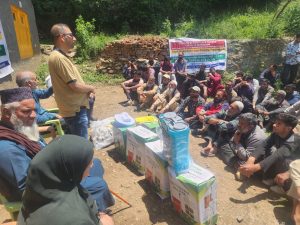
In a significant step towards strengthening livelihood opportunities and nutritional security among triba communities, the Division of Vegetable Science, Sher-e-Kashmir University of Agricultural Sciences and Technology of Kashmir (SKUAST-K), organized an Input Distribution-cum-Awareness Programme for tribal farmers of Nagwani-Dardpora, Arin, Bandipora under the Tribal Sub-Plan (TSP) Project titled “Transforming Tribal Agriculture in Kashmir: A Comprehensive Vegetable Development Initiative”, sponsored by the Indian Council of Agricultural Research (ICAR).
The programme was conducted under the guidance of Prof. Ishfaq Abidee, Head, Division of Vegetable Science, and Dr. Asima Amin, Assistant Professor and Principal Investigator of the project, with the objective of promoting scientific vegetable cultivation and enhancing the socio-economic well-being of tribal farming households.
Addressing the participants, the experts highlighted the immense potential of vegetable cultivation as a means of improving farm productivity, household nutrition, and income generation. Farmers were sensitized about improved vegetable production technologies, scientific crop management practices, efficient utilization of natural resources, and sustainable cultivation methods suited to the local agro-climatic conditions.
As part of the programme, vegetable tool kits were distributed among 60 tribal families to facilitate the adoption of improved cultivation practices and encourage year-round vegetable production at the household level. The initiative is expected to contribute significantly towards improving access to quality planting material and strengthening nutritional security among beneficiary families.
The programme witnessed enthusiastic participation from tribal farmers, who actively engaged with scientists and sought technical guidance on various aspects of vegetable cultivation. The interactive sessions provided an effective platform for addressing field-level challenges and disseminating practical, research-based solutions to the farming community.
Speaking on the occasion, the organizers reiterated SKUAST-K’s commitment to ensuring that the benefits of agricultural research and innovation reach the remotest and underserved communities of Jammu and Kashmir. They emphasized that technological backstopping, capacity building, and timely access to quality inputs are essential for transforming tribal agriculture into a more productive, resilient, and sustainable enterprise.
The programme concluded with a renewed commitment to continue extending scientific support and extension services to tribal farmers, thereby contributing to the inclusive and sustainable development of the agricultural sector in the region.