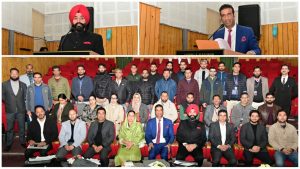
SRINAGAR, MARCH 12 Under the patronage of Chief Justice, High Court of Jammu & Kashmir and Ladakh (Patron-in-Chief, J&K Judicial Academy) Arun Palli and guidance of Chairperson and Members of the Governing Committee of the J&K Judicial Academy in collaboration with the Labour Department organised a one day training programme on “Labour Codes” was organized today at the Jammu & Kashmir Judicial Academy, Moominabad, Srinagar, for the officers and officials of the Labour Department of Kashmir Province.
The programme commenced with an introductory address by Naseer Ahmad Dar, Director, J&K Judicial Academy. He emphasized the growing importance of capacity building in understanding the evolving labour law framework. He highlighted that the consolidation of multiple labour legislations into four comprehensive labour codes marks a significant transformation in India’s labour law regime and necessitates continuous training of administrative and quasi-judicial authorities responsible for implementation.
Naseer Ahmad Dar also acknowledged the presence of Charandeep Singh, Labour Commissioner, J&K and underscored the importance of institutional collaboration between the Judicial Academy and the Labour Department in strengthening effective enforcement and interpretation of labour laws.
In his special address, Labour Commissioner Charandeep Singh stressed the need for continuous capacity building of labour officers in light of the recent labour law reforms. He appreciated the role of the J&K Judicial Academy in providing structured training programmes that enhance the professional competence of administrative and quasi-judicial officers.
The first technical session, “Overview of Labour Law Reforms: Transition from Multiple Legislations to the Four Labour Codes,” was delivered by Mir Mubashir Altaf, Assistant Professor, School of Law, University of Kashmir. He provided a detailed overview of the rationale behind labour law reforms and explained the transition from 29 central labour legislations to four consolidated labour codes. The session highlighted the objectives of simplification, rationalization, and improved compliance mechanisms within the labour law framework.
The second session was conducted by Dr. Yasir Latief Handoo, Assistant Professor, School of Law, University of Kashmir, who spoke on the Code on Social Security, 2020 and the Occupational Safety, Health and Working Conditions Code, 2020. He focused on the compliance framework, responsibilities of labour authorities, and enforcement challenges in implem’[penting these codes.
The third and concluding session was conducted by Anamika Gautam, Assistant Professor, School of Law, University of Kashmir, who discussed the Code on Wages, 2019 and the Industrial Relations Code, 2020. She elaborated on their salient features, the powers and functions of authorities under the codes, and the adjudicatory mechanisms provided therein.
The programme concluded with an interactive session and feedback, where the participants engaged with the resource persons on practical issues relating to implementation of labour codes, interpretation of statutory provisions and challenges faced in the field.
The training programme was aimed to strengthen the institutional capacity of labour department officers and officials and facilitate a better understanding of the legal, administrative and practical aspects of the newly introduced labour codes, thereby contributing to more effective labour governance in the Union Territory of Jammu & Kashmir.