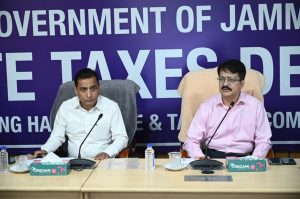
Commissioner, State Taxes Department, P.K. Bhat, today chaired a review meeting of the State Taxes Department, Kashmir, to assess the progress of tax compliance, enforcement, and revenue monitoring across the division.
The meeting was attended by the Additional Commissioner, State Taxes Kashmir, Parveez Ahmad Raina, along with State Taxes officers from all circles of the Kashmir Division.
During the meeting, the Commissioner reviewed the action taken report on cases identified through BISAG, audit cases, and the demand raised and realised for the year 2021-22. He also took stock of action initiated against non-filers, taxpayers who have received TDS payments but have not filed tax returns, scrutiny cases assigned for the year 2022-23, scrutiny of credit flow, and follow-up on notices issued by the department.
The review further covered action taken against taxpayers whose registrations have been cancelled, as well as those who have filed R1 and passed credit but have not filed GSTR-3B. The Commissioner also directed special focus on circles with a predominant hotel industry, keeping in view the revival in tourism activity, so as to check any possible revenue leakages and ensure proper tax compliance.
Commissioner P.K. Bhat emphasized the need to leverage technological tools such as PRIME, BISAG, and BIFA for more effective tax compliance, detection of irregularities, prevention of fraud, and promotion of fair trade practices. He underscored that the department must continue to strengthen enforcement mechanisms while ensuring taxpayer facilitation and accountability.
In his concluding remarks, the Additional Commissioner appreciated the efforts of the officers and urged all circles to intensify follow-up action, dispose of pending cases in a time-bound manner, and maintain a proactive approach toward revenue realization and compliance enforcement. He stressed the importance of coordinated field action, regular monitoring, and close attention to sectors with higher compliance sensitivity to further improve departmental performance.