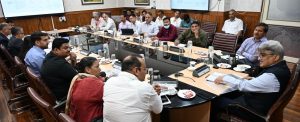
Chief Secretary, Atal Dulloo, today chaired a high-level review meeting attended by the concerned Administrative Secretaries to assess the implementation and saturation of individual beneficiary-oriented schemes being executed by various departments across Jammu and Kashmir.
During the meeting, the Chief Secretary stressed the need for ensuring complete saturation of all eligible beneficiaries under these welfare schemes by proactively reaching out to the people and generating mass awareness through different communication channels.
The Chief Secretary impressed upon all the concerned departments to bridge the gap between identified targets and beneficiaries already covered under different schemes. He directed them to make concerted efforts to ensure that the benefits of these schemes reach every intended beneficiary in a time-bound manner.
Emphasising the importance of grassroots outreach, Dulloo called for the formulation of concrete action plans to identify and enrol all eligible individuals and households under the schemes. He maintained that it is the responsibility of the administration to ensure that every deserving beneficiary receives the benefits meant for them and that leaving eligible persons uncovered would amount to a disservice to the people.
He further directed the departments to undertake periodic reviews of their respective schemes and fix measurable targets at every administrative level so that the benefits are extended to all eligible beneficiaries in a systematic and efficient manner.
Earlier, Commissioner Secretary, Planning Development and Monitoring Department, R. Alice Vaz, informed the meeting that a total of 66 beneficiary-oriented schemes are currently being implemented in the Union Territory through 18 departments. She highlighted that these schemes are designed to provide direct benefits to the people and play a crucial role in improving their socio-economic well-being.
Giving a detailed presentation, the Commissioner Secretary outlined the targeted beneficiary groups under each scheme and the nature of assistance being extended through cash transfers, food security, housing support, healthcare services, educational assistance and livelihood promotion initiatives.
The meeting was informed that among the 66 schemes under implementation, 21 are being executed by the Social Welfare Department, eight by the Health Department, seven each by the Agriculture Production Department, Rural Development Department and School Education Department, three by the Tribal Affairs Department, while the remaining schemes are being implemented by other departments.
Several flagship and high-impact schemes were reviewed during the meeting, including the Pradhan Mantri Fasal Bima Yojana (PMFBY), PM-KISAN and Sub-Mission on Agricultural Mechanization (SMAM) of the Agriculture Department; National Livestock Mission of the Animal Husbandry Department; PM Formalisation of Micro Food Processing Enterprises (PMFME) Scheme of the Horticulture Department; One Nation One Ration Card initiative of the Food, Civil Supplies and Consumer Affairs Department; PMAY-Gramin and Himayat of the Rural Development Department; PM Surya Ghar Yojana; PM Vishwakarma; besides various scholarship and pension schemes being implemented by the Social Welfare Department.
The meeting also reviewed schemes being implemented by the Health, School Education and Skill Development Departments aimed at enhancing health indicators, educational opportunities and strengthening skill development among the populationof Jammu and Kashmir.
The Chief Secretary reiterated thatthetargeted outreach, regular monitoring and public awareness would be key to achieving saturation under these schemes and ensuring that the intended benefits reach every eligible citizen across the UT.