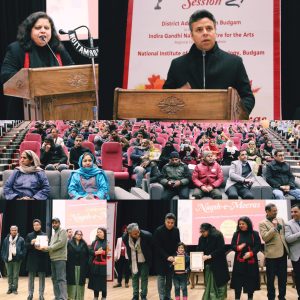
BUDGAM, FEBRUARY 07:The three-day cultural and heritage workshop “Naqsh-e-Meeras” today concluded with a grand Valedictory Session at the National Institute of Fashion Technology (NIFT), Budgam, marking the successful culmination of a flagship initiative aimed at preserving, promoting and revitalising the traditional arts and crafts of Jammu & Kashmir.
The workshop was organised by the District Administration Budgam in collaboration with the Indira Gandhi National Centre for the Arts (IGNCA), Regional Centre Jammu Kashmir, and the National Institute of Fashion Technology (NIFT), Budgam.
The valedictory function was Chaired by Deputy Commissioner Budgam, Dr. Bilal Mohi-ud-Din Bhat.
Besides, Regional Director IGNCA, Shruti Awasthi, other officers from IGNCA, Director NIFT, Prof. Dr. Monika Gupta, the event was attended by senior district officers including General Manager, District Industries Centre (DIC) Budgam, Zahid Rashid; Sub Divisional Magistrate Beerwah, Taufeeq Gazi; Chief Planning Officer Budgam, Javaid Ahmad Najar; Chief Executive Officer, Municipal Council Budgam, Bilal Ahmad; Chief Education Officer Budgam, Rifat Irfan; District Information Officer Budgam, Iram Khan; Executive Officer, Municipal Committee Beerwah, Zamir Lone, and other senior officers of the district administration.
Also, large participation was recorded from students of various schools and colleges, local youth, traditional artisans, Self Help Groups, craftspersons and members of the general public, reflecting strong community engagement and growing interest in heritage preservation.
Speaking on the occasion, the DC stated that Budgam district is widely recognised as the cradle of craftsmanship in Kashmir, with a deep-rooted legacy of traditional arts and crafts that have been nurtured over centuries.
He said that a large section of the population in Budgam is directly or indirectly associated with one craft or another, making handicrafts not only a cultural asset but also a vital source of livelihood.
He highlighted that Budgam is home to renowned craft traditions including Sozni embroidery, Kani shawl weaving, Tilla embroidery, copperware, wood carving, papier-mâché, carpet weaving, Kangri making, willow wicker work and traditional handloom weaving, reflecting the artistic excellence and heritage skills of the region.
The DC emphasised that the core objective of Naqsh-e-Meeras was to preserve the originality and authenticity of handcrafted products, and to sensitise people, especially the younger generation, to clearly distinguish between handmade and machine-made items, in order to protect quality, heritage value and the identity of Kashmiri crafts.
The DC further highlighted the development of Kanihama Craft Village as an integrated craft hub, where facilities such as single-window sale outlets, medical and health facilities and other basic infrastructure are being provided within one campus to ensure holistic support to artisans. He added that traditional Kani shawl weaving is being preserved and promoted at Kanihama, ensuring continuity of this globally renowned heritage craft.
He stated that programmes like Naqsh-e-Meeras help in creating vital linkages between heritage and contemporary markets, opening new avenues for artisans, increasing demand for authentic handmade products and strengthening sustainable livelihoods.
“These initiatives are aligned with the spirit of Vocal for Local and will help strengthen local economies while safeguarding our cultural identity,” the DC said.
The valedictory ceremony was further enriched by vibrant cultural performances including local Band Pather, traditional folk songs and folk dance performances, which showcased Kashmir’s living cultural traditions and added colour to the event.
A felicitation ceremony was also held, during which participants who excelled in art, calligraphy, shawl weaving, copper work, Tilla embroidery and Sozni embroidery were awarded and honoured in recognition of their skill, creativity and dedication.
The successful conclusion of Naqsh-e-Meeras marked a significant milestone towards strengthening cultural preservation, artisan empowerment, youth engagement and sustainable economic development in Budgam district, while reaffirming the district’s position as a vital hub of Kashmir’s traditional craftsmanship.