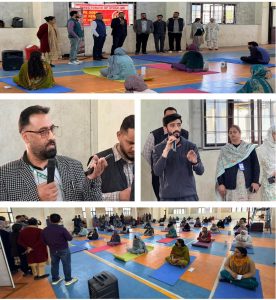
AWANTIPORA, APRIL 13: As part of academic outreach initiative, students from Government Degree College (GDC), Anantnag, visited the Department of Journalism and Mass Communication (DJMC), Islamic University of Science and Technology (IUST), on Monday.
During the visit, the students were given a comprehensive tour of the department’s I-Mac equipped Media Lab, Community Radio Station (CRS), Multimedia Studio, Smart Classroom and departmental library. The programme aimed at bridging the gap between academic learning and practical exposure.
Welcoming the students, Head of the Department, Dr. Rabia Noor, briefed them about the Master’s programme, highlighting its focus on hands-on training and industry-oriented learning. She informed them that the curriculum has been framed in alignment with the National Education Policy, 2020.
Dr. Monisa Qadri, Senior Assistant Professor, interacted with the students and spoke about career prospects in the field of media, encouraging them to explore emerging opportunities in journalism and communication.
On the occasion, a departmental profile video was screened, and copies of IUST’s news magazine, Times Echo were distributed among the visiting students.
The visit also featured a series of hands-on technical sessions. Dr. Mujeeb Liyakat, Coordinator CRS and Assistant Professor, DJMC, guided the students through the process of radio programme production, offering insights into recording and broadcasting. The students also participated in a short recording session.
In the Multimedia Studio, Dr. Sayar Ahmad Mir, Assistant Professor, DJMC, familiarised the students with newsroom practices, along with the fundamentals of lighting and video editing. Zahoor Ahmad, Junior Technical Assistant, DJMC, conducted a session in the Media Lab, introducing students to basic camera operations and media career prospects.
In the Smart Classroom, Dr. Haifa Mohammad engaged the students in interactive activities designed to enhance their communication and news framing skills. As part of the visit, the students were also taken to the departmental library, where they were introduced to academic resources and research facilities.
The programme concluded with a visit to the university’s synthetic athletic track, giving the students a glimpse of the campus infrastructure. The visit provided valuable exposure to both the academic and practical dimensions of media education, enriching the students’ understanding of the field.