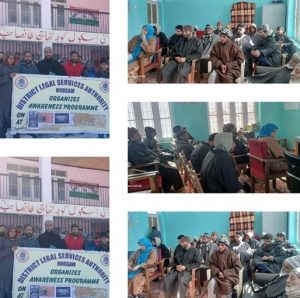
BUDGAM, FEBRUARY 12: District Legal Services Authority (DLSA), Budgam, organized an awareness programme on the Scheduled Castes and Scheduled Tribes (Prevention of Atrocities) Act, 1989 at the Legal Aid Clinic, Khan Sahib, Budgam.
The programme aimed to educate the general public about the rights, protections, and safeguards available to members of the Scheduled Castes (SC) and Scheduled Tribes (ST) under the Act. Emphasis was laid on preventing atrocities, safeguarding dignity, and ensuring equal access to justice.
During the session, Zahoor Ahmad Malik, Assistant LADC Budgam, elaborated on the salient features of the Act, including the procedure for lodging complaints, provisions related to compensation and rehabilitation of victims, and the role of various authorities in ensuring effective implementation of the law. He highlighted that the Scheduled Castes and Scheduled Tribes (Prevention of Atrocities) Act, 1989, as amended in 2015 and 2018, provides comprehensive legal safeguards to protect SC/ST individuals from violence, social humiliation, and economic exploitation. The Act seeks to promote social justice, dignity, and equality by criminalizing specific acts of atrocity and ensuring speedy trial and rehabilitation for victims.
Participants were also informed about the availability of free legal aid and assistance through DLSA Budgam.
DLSA Budgam reiterated its commitment to organizing legal awareness camps in vulnerable areas to sensitize SC/ST communities about their rights, compensation mechanisms, and access to legal aid services. Sensitization programmes aimed at promoting social harmony and discouraging caste-based discrimination will also be conducted to foster inclusiveness and uphold constitutional values.
The speaker further emphasized that strengthening initiatives for Scheduled Castes and Scheduled Tribes is essential to address systemic discrimination and ensure effective access to justice. Such efforts must be aligned with the framework of the SC/ST (Prevention of Atrocities) Act, 1989, and supported by institutions like the National Legal Services Authority (NALSA).
The programme witnessed active participation from students and faculty members, who appreciated the initiative and expressed the need for continued awareness activities to further strengthen social justice and equality.